
Styles and Headings Stay Applied
Paragraph styles, heading levels, fonts and emphasis are carried over to the translated text, so the document outline and navigation keep working.
Translate a Word document online. Upload your DOCX, choose a language and review headings, tables and page breaks in the result.
Translation example
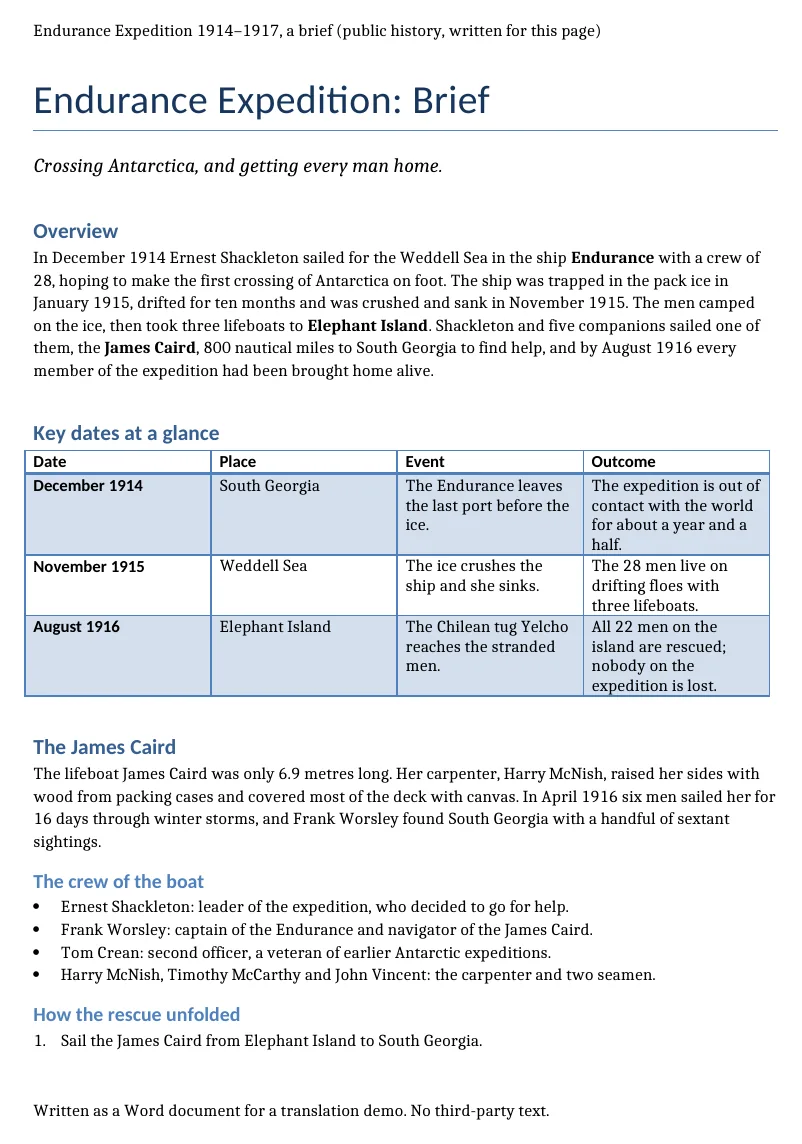
A short brief on Shackleton's Endurance expedition (1914–1917), written for this page as a Word file: title, headings, a shaded table, bold text, bullet and numbered lists, a header and a footer. The numbers below were counted from the two files.
Source
Result
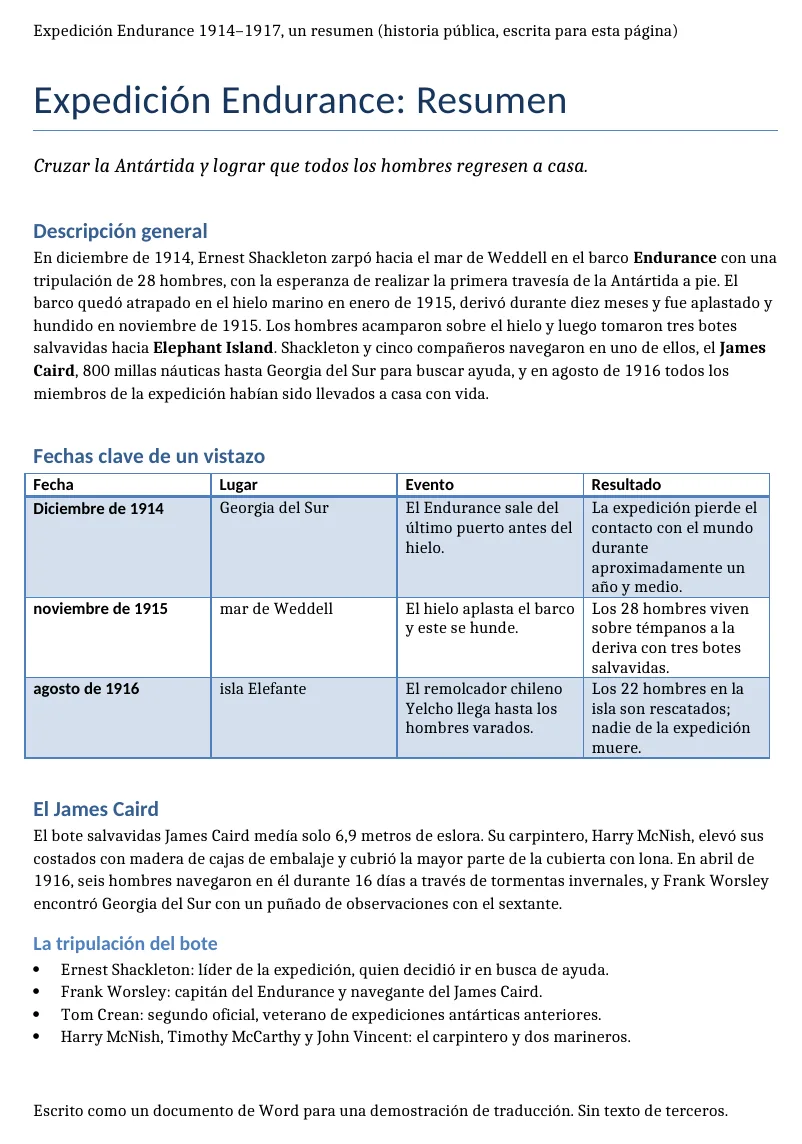
The document declares Spanish, so Word does not underline every word.
“Elephant Island” stays in English in the text but becomes “isla Elefante” in the table, and “Weddell Sea” is lower-cased. Pin names like this with a glossary.
2026-10-09 verified — Amanda Lee
Paragraph styles, heading levels, fonts and emphasis are carried over to the translated text, so the document outline and navigation keep working.
Table structure, nested lists, numbering and image positions are preserved. Cell text is translated where it stands — no columns collapsing into paragraphs.
The result is a standard DOCX that opens in Microsoft Word and other DOCX-compatible editors. Fix a term or update a section without converting anything.
Documents are encrypted in transit and at rest. How long they are kept depends on your plan.
DOCX belongs to the Office Open XML family documented in ECMA-376. Keep the original document and compare headings, table cells and page breaks after translation. Use the Word workflow when you need to continue editing document text.
If your document has an automatic table of contents, Microsoft explains how to refresh it in Word: select Update Table on the References tab, then Update entire table to refresh both heading text and page numbers. A manually typed table of contents needs manual editing.
Upload your Word document
Drag and drop the DOCX file or browse for it. The maximum file size depends on your plan.
Choose the target language
Pick from 100+ languages. The source language is detected automatically, so you only choose where the text should go.
Let the structure be translated in place
Paragraphs, tables, lists and headers are translated inside the document structure, keeping terminology consistent across sections.
Download and keep editing
Open the translated DOCX in Word as usual. Refresh the table of contents if the document has one — heading text has changed.
Upload the DOCX and pick a target language. ForgeFile parses the document structure first — styles, tables, lists, headers — and writes the translated text back into it, so the downloaded file keeps its formatting and stays editable.
Yes. The output is a standard DOCX that opens in Microsoft Word and other editors that support the format. You can continue editing it like any other document.
Table structure, nested lists, numbering, image positions and hyperlinks are kept in place. Text inside table cells is translated where it stands.
More than 100 languages, including Spanish, French, German, Portuguese, Arabic, Hindi, Chinese, Japanese and Korean, with support for right-to-left scripts.
The maximum file size depends on your plan. For larger documents or high-volume batch work, contact us about enterprise plans with higher limits.
Free and paid plans are available. Paid plans add larger files, more volume and API access — see the pricing page for the full comparison.
Line and page breaks can shift because translated text changes length, and Word-generated elements such as a table of contents or cross-references need a refresh inside Word. Terminology in headings is worth a quick scan for critical documents.
Files are encrypted in transit and at rest. How long they are kept depends on your plan.
Translate a Word document online. Upload your DOCX, choose a language and review headings, tables and page breaks in the result.